 blog
Is Anxiety Counseling the Best Support for Mental Health?
Last Updated: October 25, 2026
Quick Summary
Anxiety counseling is a structured, evidence-based form of mental health care that helps you understand anxious thoughts, calm your body's stress response, and rebuild daily functioning. It works best when matched to your needs, such as CBT for thought-driven worry or EMDR for trauma-driven anxiety, and combined with supports like exercise and sleep.
- CBT is among the most evidence-supported treatments for anxiety disorders, typically spanning 12 to 20 weekly sessions.
- The National Institute of Mental Health notes that 30 minutes of daily walking can boost mood.
- Individual anxiety counseling comes first when anxiety is severe or trauma memories are raw.
- Most anxiety counseling starts weekly, especially in the first 8 to 12 weeks.
- If you see no meaningful change after 6 to 8 sessions, review the approach, fit, or intensity of care.
Table of Contents
- Why Anxiety Counseling Supports Mental Health and Overall Well-Being
- Anxiety Therapy Options Compared: CBT, EMDR, DBT, and More
- Coping Mechanisms for Anxiety That Complement Counseling
- Anxiety Support Groups: When Group Settings Help
- How to Choose an Anxiety Therapist and Evaluate Fit
- What to Expect in the First Sessions and How Progress Is Measured
- Costs, Insurance, and Affordability for Anxiety Counseling
- Finding the Right Counseling Support at The Wellness Counselors
- Frequently Asked Questions
Why Anxiety Counseling Supports Mental Health and Overall Well-Being
Anxiety counseling is a structured, evidence-based form of mental health care that helps people understand anxious thoughts, calm the body's stress response, and rebuild daily functioning.
The scale of the problem is real. Suicide was the 10th leading cause of death overall in the U.S. in 2024, according to the National Alliance on Mental Illness mental health statistics.
The American Psychiatric Association reported that 59% of Americans felt anxious about personal finances and 53% felt anxious about uncertainty over the next year, per its 2026 mental health resolutions release.
Below, we explain what anxiety counseling actually does, how the main therapy options compare, and how to judge whether a counselor is the right fit.
How Anxiety Affects Daily Functioning
Anxiety shows up in the body first. Racing heart, tight chest, shallow breathing, a stomach that won't settle. Then it spreads into behavior: avoiding meetings, checking things repeatedly, snapping at family, lying awake at 2 a.m.
In practice, this means anxiety quietly shrinks a person's world. Work performance drops. Social plans get cancelled. Small tasks feel heavy.
Common daily effects include:
- Trouble focusing on tasks for more than a few minutes
- Sleep that takes hours to arrive, then breaks apart
- Irritability with partners, kids, or coworkers
- Physical tension in the jaw, shoulders, and gut
- Avoidance of situations that used to feel normal
None of this is a character flaw. It is a nervous system stuck in threat mode, and it responds well to structured care.
Anxiety Therapy Options Compared: CBT, EMDR, DBT, and More
The best anxiety therapy options differ in what they target: thoughts, behaviors, body memory, or emotional regulation. Cognitive behavioral therapy (CBT) is among the most evidence-supported treatments for anxiety disorders, according to a 2024 Journal of Safety Research article on personalized mental health interventions.
Here is how the main approaches compare on the dimensions that matter for a decision.
| Approach | Best For | Core Method | Typical Format | Evidence Strength | Typical Time Commitment | Key Trade-Off |
|---|---|---|---|---|---|---|
| CBT | Worry, panic, specific fears | Identify and test anxious thoughts; behavioral experiments | Weekly sessions, homework | Strong for most anxiety disorders | 12-20 weekly sessions | Requires active practice between sessions; not ideal if you want to avoid homework |
| EMDR | Trauma-driven anxiety, PTSD | Bilateral stimulation during memory recall | 60-90 minute sessions | Strong for PTSD; growing for other anxiety | 8-12+ sessions, often longer for complex trauma | Requires readiness to process distressing memories; can be emotionally intense |
| DBT | Overwhelming emotions, self-harm risk | Skills for distress tolerance and regulation | Group plus individual | Strong for emotion dysregulation; moderate for anxiety alone | 6+ months, weekly skills group and individual | Time-intensive; may be more than needed for simple anxiety |
| Exposure therapy | Phobias, avoidance, OCD | Gradual, guided contact with feared situations | Structured step plans | Strong for phobias and OCD | 8-15 sessions, often with homework | Requires willingness to face feared situations; anxiety may rise before it falls |
| Mindfulness-based therapy | Chronic worry, rumination | Present-moment awareness and grounding | Weekly practice plus home work | Moderate; helpful as adjunct | 8-week programs common | Benefits build slowly; not a quick fix for acute panic |
A simple rule: if anxiety traces back to a specific trauma, EMDR or trauma-focused work often fits. If anxiety is generalized and thought-driven, CBT is a strong first stop.
Evidence quality and limitations. CBT has the largest body of randomized controlled trials for anxiety disorders, but response rates vary, many people improve substantially, while others need additional approaches.
Treatment trade-offs. More intensive approaches (DBT, trauma-focused work) demand more time and emotional energy but may address deeper patterns. Brief structured approaches (CBT, exposure) can produce faster symptom relief but require consistent practice.
Coping Mechanisms for Anxiety That Complement Counseling
Coping mechanisms for anxiety work best as support, not as a replacement for treatment. The National Institute of Mental Health recommends regular exercise, healthy regular meals, hydration, prioritized sleep, and relaxing activities, and notes that 30 minutes of daily walking can boost mood.
That is a low bar anyone can clear. A 30-minute walk, most days, is real medicine for an anxious nervous system.
Grounding techniques help in the moment. Try these:
- 5-4-3-2-1 grounding: name 5 things you see, 4 you feel, 3 you hear, 2 you smell, 1 you taste
- Box breathing: inhale 4 counts, hold 4, exhale 4, hold 4
- Cold water on the wrists: a fast way to reset the nervous system
- Feet on the floor: press down and notice the contact for 30 seconds
Values-based steps matter too. Anxiety pushes people toward avoidance. Choosing one small action aligned with your values, even while anxious, retrains the brain over time.
We keep a fuller list in our guide to methods to manage stress.
Anxiety Support Groups: When Group Settings Help
Anxiety support groups help most when someone needs connection, accountability, and shared language between individual sessions. Group therapy adds something one-on-one work cannot: proof that other people feel this too.
Group settings fit well when:
- You feel isolated by your anxiety
- You want practice talking in front of others
- Cost is a barrier to weekly individual therapy
- You are already in individual care and want more support
They fit less well when anxiety is severe, when trauma memories are raw, or when you need private, paced processing. In those cases, individual anxiety counseling comes first.
A common mistake is treating a support group as a substitute for treatment. It is a complement. Groups build skills and reduce shame. They do not replace a personalized treatment plan.
How to Choose an Anxiety Therapist and Evaluate Fit
Choosing an anxiety therapist comes down to four checks: credentials, specialty, method, and fit. Get all four right and therapy moves faster.
Start with credentials and licensing. In the U.S., look for licensed professionals such as LPC, LCSW, LMFT, or licensed psychologists.
Then check specialty. A therapist who treats trauma and anxiety daily will ask sharper questions than a generalist. Ask what percentage of their caseload is anxiety or trauma work.
Ask about method. Which approaches do they use for anxiety, and why? A good answer names specific modalities and explains when they use each.
Use this checklist before booking:
- License and state verified
- Anxiety or trauma listed as a specialty
- Clear explanation of the treatment method
- Session length and frequency stated upfront
- Insurance and out-of-pocket costs explained
- A plan for how progress will be measured
Fit is the last piece, and it is real. You should feel heard in the first session, not processed.
What to Expect in the First Sessions and How Progress Is Measured
The first sessions focus on assessment and planning, not immediate deep work. Expect questions about symptoms, history, sleep, health, and goals. Expect a treatment plan within the first few meetings.
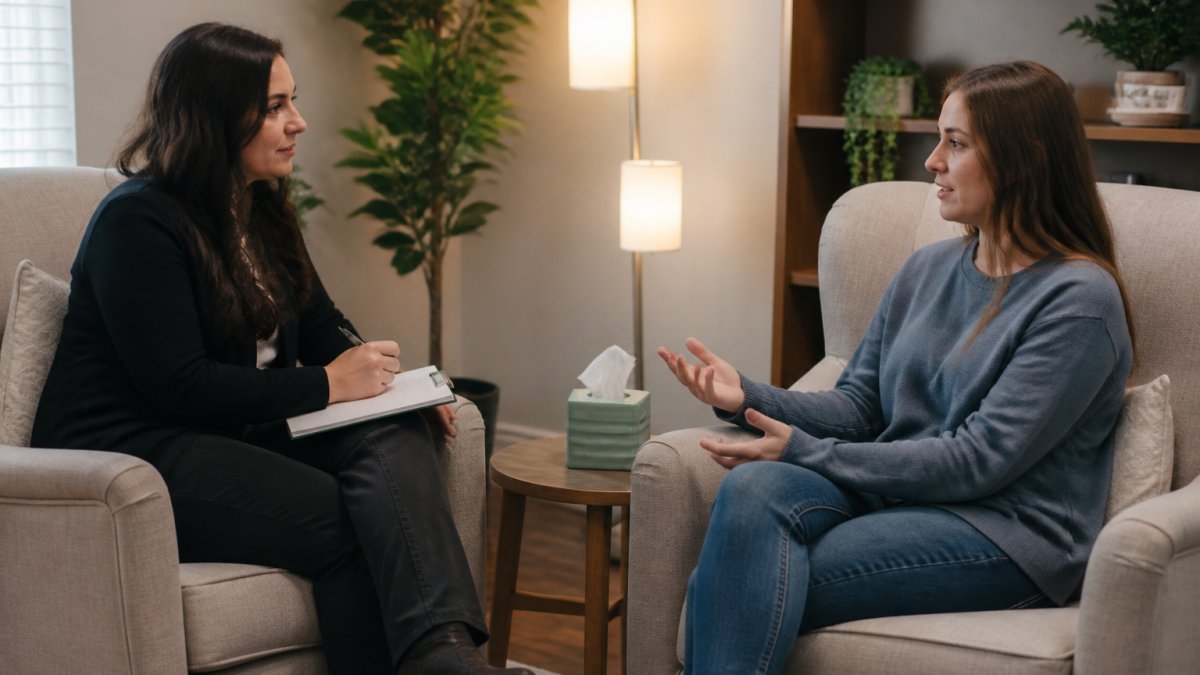
Sessions two and three: goal setting and treatment planning. By the second or third meeting, you and your therapist should agree on specific, measurable goals. Instead of "feel less anxious," goals might be "sleep through the night at least five nights a week" or "attend one social event per week without cancelling." The plan should name the chosen methods (e.g., CBT, exposure), the expected frequency and length of sessions, and a rough timeline for review. Ask for this in writing if it helps.
Session cadence. Most anxiety counseling starts weekly, especially in the first 8-12 weeks. As symptoms improve, sessions may move to biweekly or monthly. Some approaches, like exposure therapy, may require more frequent or longer sessions initially.
How progress is measured. Good therapists track change in plain, observable ways:
- Symptom check-ins at the start of each session using brief rating scales
- Sleep, appetite, and energy tracking
- Avoidance lists getting shorter
- Functioning at work, school, and home improving
- Feedback from your own weekly ratings of anxiety and mood
Progress is rarely a straight line. A hard week is not a sign therapy is failing. Bring it to session and let your counselor adjust the plan.
Costs, Insurance, and Affordability for Anxiety Counseling
Cost is the question most people ask last and worry about first. Anxiety counseling pricing depends on the provider, session length, and insurance coverage, so ask for a written estimate before your first appointment.
Ways to make care affordable:
- Insurance: check whether the practice is in-network before booking
- Employee assistance programs: many employers offer free short-term sessions
- Sliding scale fees: ask directly; many practices offer them
- Group therapy: often lower cost per session than individual work
- Telehealth: can reduce travel and time off work
Digital mental health interventions are also being studied as a way to widen access. A 2019 Journal of Medical Internet Research review found that digital interventions can be effective for improving depression, anxiety, and psychological well-being.
If you have Blue Cross Blue Shield, Anthem, Cigna, or United Healthcare, ask the practice to confirm in-network status in writing before your first visit. Billing surprises are common and avoidable.
Finding the Right Counseling Support at The Wellness Counselors
Finding the right support means matching the method to the problem and the counselor to the person. That is where we come in.
The Wellness Counselors specializes in EMDR therapy, trauma recovery, and anxiety management. Our practice utilizes diverse therapeutic modalities to deliver instructive, detailed, and highly personalized support for your unique healing journey. Evening appointments are available.
If you have tried therapy before and it didn't really help, EMDR works differently. It targets how memories are stored, not just how you talk about them. If your anxiety is affecting work and you are unsure whether EMDR fits, that is exactly the kind of question we answer in a first consultation.
Frequently Asked Questions
Can counseling help with anxiety and overall well-being?
Yes. Research in the Journal of Medical Internet Research (2019) found that digital mental health interventions can be effective for improving depression, anxiety, and psychological well-being. In-person anxiety counseling works similarly: cognitive behavioral therapy is among the most evidence-supported treatments for anxiety disorders, according to a 2024 article in the Journal of Safety Research. Counseling also supports overall well-being by building coping skills, improving sleep and daily functioning, and reducing the worry and fear that interfere with work and relationships.
What are some effective coping mechanisms for anxiety?
The National Institute of Mental Health recommends regular exercise, healthy regular meals, hydration, prioritizing sleep, and relaxing activities, noting that 30 minutes of daily walking can boost mood. Grounding techniques and somatic grounding help calm the nervous system during a panic spike, while mindfulness practices and values-based steps reduce avoidance over time. These coping mechanisms for anxiety work best alongside anxiety counseling, where a therapist can tailor them to your specific triggers and treatment plan.
How do I choose the right type of counseling for anxiety?
Start with the evidence: CBT is among the most evidence-supported treatments for anxiety disorders, while EMDR is specifically used for trauma and PTSD, and DBT helps with emotional regulation. Ask whether the therapist offers in-person therapy or telehealth, whether they accept your insurance, and how they personalize treatment. A short consultation lets you evaluate fit, ask about their approach, and confirm they treat your specific concern before committing to ongoing sessions.
What should I expect in an anxiety counseling session?
The first sessions usually cover your history, current symptoms, and goals, and a treatment plan is developed within the first few meetings. Progress is assessed through symptom tracking and changes in daily functioning. The American Psychiatric Association reported in 2026 that 59% of Americans felt anxious about personal finances and 53% about uncertainty over the next year, so money worries are a common topic in counseling.
Anxiety does not have to run your days. If you are ready to stop managing symptoms alone, The Wellness Counselors offers EMDR therapy, trauma recovery work, and anxiety management with evening appointments to fit real schedules. Get started with The Wellness Counselors and take the first step toward steadier days.